Synthetic Biology Market Forecast, 2025-2032
Global Synthetic Biology Market Size by Product Type (Synthetic DNA, Synthetic Genes, Synthetic Cells, Chassis Organisms, Xeno-nucleic Acids (XNAs), Enzymes), Technology (Gene Synthesis, Genome Engineering, Bioinformatics, DNA Sequencing, Biological Components & Integrated Systems), Application, And Regional, Global Market Analysis and Forecast, 2025-2032
Report ID- 1028| Number of pages- 250
Report Industry- Healthcare | Published on- December 2025
Request Sample Buy NowMarket Overview:
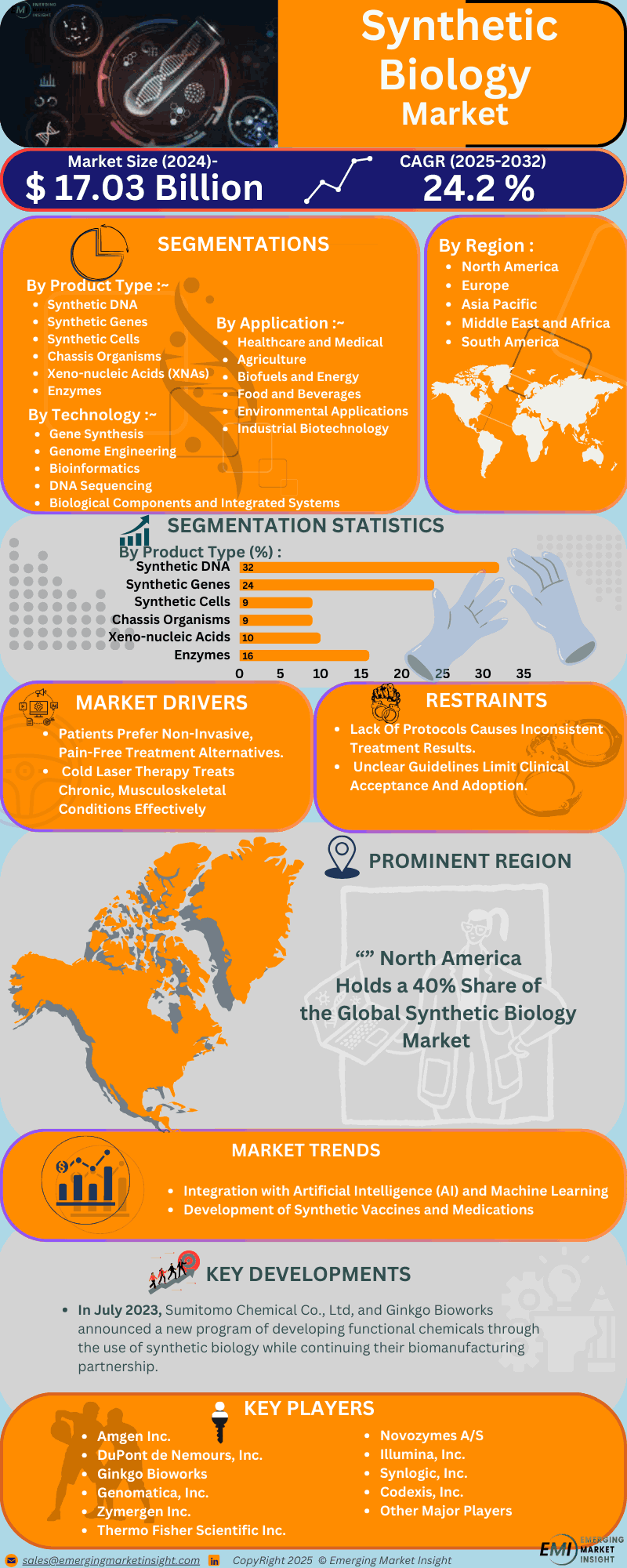
The Global Synthetic Biology Market, valued at USD 17.03 billion in 2024, is forecasted to grow to USD 96.42 billion by 2032, with a steady CAGR of 24.2% from 2025 to 2032
Synthetic biology develops rapidly because of the technological improvements in genetic engineering, biotechnology, and AI. Synthetic biology covers two areas of work: implementing the creation of new biological elements as well as adapting existing natural biological systems to operate for useful needs. Medical and agricultural industries and environmental management sectors, together with biofuel production, require synthetic organisms while seeking biochemicals and bioengineering tools, and techniques. The market leaders put their resources into development activities to boost their product ranges while creating fresh inventions. Government funding combined with private investments serve as additional growth factors that strengthen the market expansion. The sustainable and efficient solution needs consumer support for market expansion while driving its growth.

Market Dynamics:
Drivers:
Advancements in Genetic Engineering and Biotechnology
The synthetic biology market moves forward because of genetic engineering and biotechnology advancements, which allow researchers to make precise genetic material modifications for creating customized biological systems. Standout innovations from researchers permit design work and organism engineering, which produces better function-based organisms that help advance medical discovery alongside agricultural and industrial biotechnology applications. Improved DNA editing through CRISPR techniques and other strategies has elevated research productivity through higher accuracy and market-driving cost reductions. The combination of bioinformatics and automation advancements in synthetic biology has made it possible the develop efficient and sustainable bio-based product production methods. Market expansion occurs because industries search for creative, environmentally-friendly solutions backed by these advances.
Restraint:
High Research and Development Costs
Research and development expenses, together with capital costs, prove to be major obstacles in the synthetic biology market. Synthetic organism and biological system development require substantial financial support for specialized tools and personnel, while laboratories need advanced facilities to perform tests successfully. The expensive nature of synthetic biology experiments makes both experimentation and verification testing requirements expensive. When buying advanced materials and technologies, including gene-editing tools and bioinformatics software for R&D activities, companies face inflation in research expenses. Startups and several other companies confront financial obstacles that restrict their capacity for innovation while they try to grow their operations, which delays the release of synthetic biology products into the market.
Opportunity:
Growing Demand for Bio-Based Chemicals and Fuels
The synthetic biology market has strong prospects due to rising bio-based chemicals and fuel requirements. Bio-based chemicals, together with fuels, represent environmentally beneficial alternatives to petroleum products, which are now being actively pursued by both industries and consumers. A combination of synthetic biology techniques allows scientists to manufacture beneficial chemical products through microorganism modifications that transform biomass into marketable materials, thus diminishing dependence on petroleum fuels and environmental pollution. The growth of green technologies receives support from regulations, which also provide incentives to decrease carbon emissions. The development of metabolic engineering and synthetic biology allows the addressing of this demand by creating affordable, scalable, bio-based solutions for industry needs.
Segmental Analysis of the Synthetic Biology Market
By Product Type, the synthetic DNA Segment is expected to dominate the Market during the Forecast Period 2025-2032
The construction of synthetic genes alongside artificial cells and biological components occurs through synthetic DNA, which drives innovation in the genetic engineering and biotechnology fields. The expanding need for individualized healthcare treatments combined with gene therapies research and synthetic biology investigations produces strong market expansions in this segment. DNA synthesis technologies have progressed through high-throughput synthesis techniques along with CRISPR-based methods to create lower prices and higher efficiency rates, which have made synthetic DNA more available. The market leadership position strengthens because the government and private sectors provide extensive research support and financial investments.
Regional Analysis of the Synthetic Biology Market:
North America (NA) will lead the Global Synthetic Biology market throughout the forecast period.
The synthetic biology market is primarily concentrated in North America because it benefits from superior investment in science, its robust biotechnology foundation, and enabling regulations. Synthetic biology companies, along with research organizations and start-ups specializing in this field, converge in the North American region, particularly throughout the United States. Government funding, together with private investment, actively drives innovation, which advances healthcare and agriculture and biofuel technology. Additionally, North America's skilled workforce and collaboration between academia and industry foster rapid technological progress. Synthetic biology applications find support through sustainability practices in the region, which enhances its dominant market position. Because of this, North America operates as the market leader and continues to generate significant market growth.
Recent Development of the Global Synthetic Biology Market:
- In July 2023, Sumitomo Chemical Co., Ltd, and Ginkgo Bioworks announced a new program for developing functional chemicals through the use of synthetic biology while continuing their biomanufacturing partnership.
- In January 2023, NREL launched a synthetic biology project with LanzaTech, Northwestern, and Yale to improve biofuel discovery technologies. The work was to be on genome engineering and machine learning to rapidly identify solutions for large-scale production with negative carbon release for biofuels and biochemicals.
Key Players in the Global Synthetic Biology Market
· Amgen Inc.
· DuPont de Nemours, Inc.
· Ginkgo Bioworks
· Genomatica, Inc.
· Zymergen Inc.
· Thermo Fisher Scientific Inc.
· Novozymes A/S
· Illumina, Inc.
· Synlogic, Inc.
· Codexis, Inc.
· Other Major Players
Scope of the Report
By Product Type:
· Synthetic DNA
· Synthetic Genes
· Synthetic Cells
· Chassis Organisms
· Xeno-nucleic Acids (XNAs)
· Enzymes
By Technology:
· Gene Synthesis
· Genome Engineering
· Bioinformatics
· DNA Sequencing
· Biological Components and Integrated Systems
By Application:
· Healthcare and Medical (e.g., drug discovery, synthetic vaccines)
· Agriculture (e.g., genetically modified crops, biofertilizers)
· Biofuels and Energy
· Food and Beverages
· Environmental Applications (e.g., bioremediation)
· Industrial Biotechnology (e.g., bio-based chemicals)
By Region
· North America (NA):
o United States
o Canada
o Mexico
· Europe (EU):
o Germany
o United Kingdom
o France
o Italy
o Spain
o Rest of Europe (including Netherlands, Sweden, Belgium, etc.)
· Asia-Pacific (APAC):
o China
o Japan
o India
o South Korea
o Australia
o Rest of Asia-Pacific (including Southeast Asia, New Zealand, etc.)
· Middle East & Africa (MEA):
O Saudi Arabia
o United Arab Emirates (UAE)
o South Africa
o Egypt
o Rest of Middle East & Africa (including Kuwait, Nigeria, etc.)
· South America (SA):
o Brazil
o Argentina
o Chile
o Rest of South America (including Colombia, Peru, etc.)
Frequently Asked Questions
Report Purchase options
Report Customization
- Dedicated Research on any specific segment or region.
- Focused Research on specific players in the market.
- Custom Report based only on your requirements.
- Flexibility to add or subtract any chapter in the study.
- Historic data from 2019 and forecast outlook till 2032.
- Flexibility of providing data/insights in various formats (PDF, PPT, Excel).
- Provide cross-segmentation in applicable scenarios/markets.