
Virtual Prototype Market Forecast, 2025-2032
Global Virtual Prototype Market Size Technology by Component (Software, Hardware), Deployment Mode (On-Premises, Cloud-Based), Application (Automotive, Aerospace, Consumer Electronics, Healthcare, Industrial Machinery, Construction, Others), And Regional, Global Market Analysis and Forecast, 2025-2032
Report ID- 1032| Number of pages- 250
Report Industry- IT and Telecom | Published on- January 2025
Request Sample Buy NowMarket Overview:
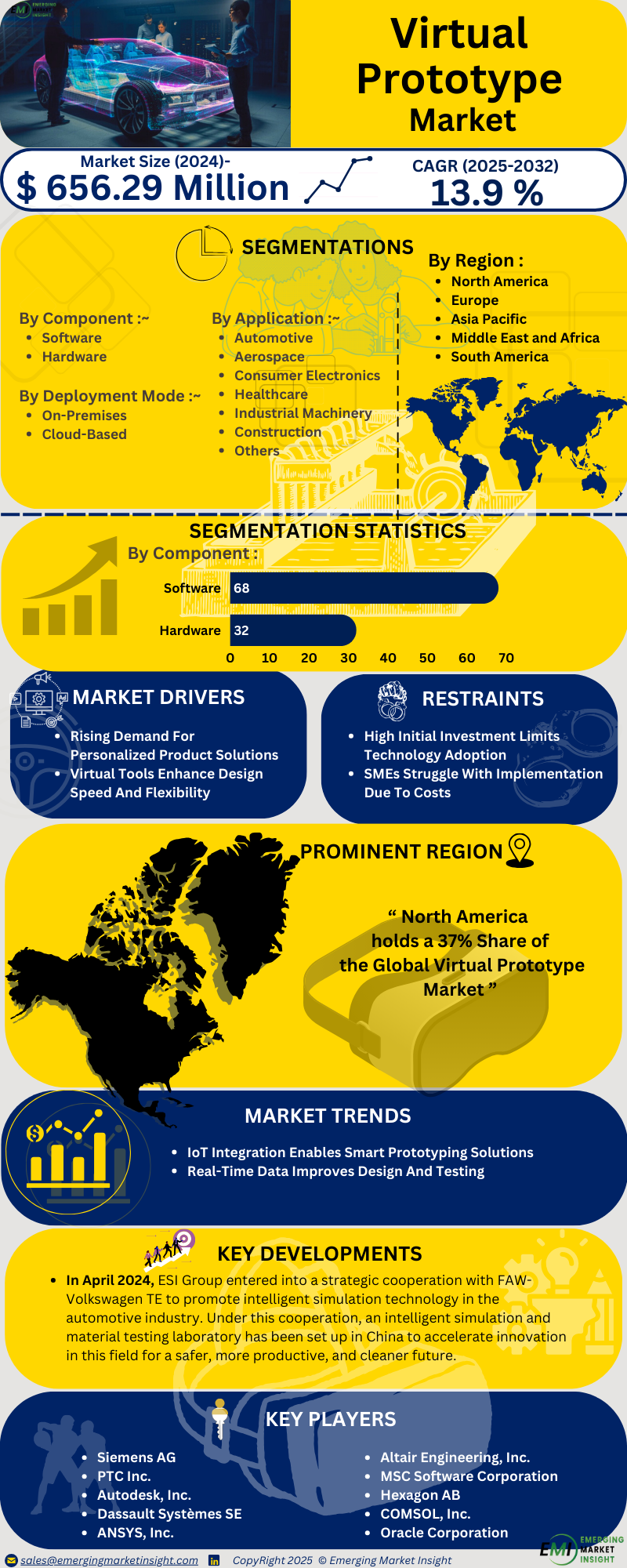
The Global Virtual Prototype Market, valued at USD 656.29 million in 2024, is projected to grow to USD 1,859.03 million by 2032, with a steady compound annual growth rate (CAGR) of 13.9% from 2025 to 2032.
The market for virtual prototypes is growing rapidly, driven by technological advancements and increasing pressure from companies to develop cost-efficient products. Virtual prototyping is one of those enabling methodologies that enables companies to create virtual models of their products, wherein simulation, testing, and validation are performed before the production of the product. This shortens the time taken for development with reduced costs and improves the accuracy of the design. Automotive, aerospace, and consumer electronics are some of the major markets for virtual prototyping technologies. Such technologies facilitate innovation and product quality enhancements. The market is now moving towards even more artificial intelligence, machine learning, and cloud-based solutions that can further expand virtual prototyping tool capabilities within the next couple of years.

Market Dynamics:
Drivers:
Increasing Demand for Customization
The virtual prototype market experiences growth because businesses actively seek to meet individual customer requirements and preferences. The current market environment demands personalized products because they create better satisfaction for customers and create stronger brand loyalty. Virtual prototyping helps companies expedite design creation along with modification while reducing traditional prototyping expenses through efficient and fast operations. The tool enables faster design executions and faster market trend responses while receiving customer feedback. Organizations gain the ability to manufacture various customized products for the market because of this development, resulting in increased market appeal and differentiation.
Restraint:
High Initial Investment
Large initial costs act as an important barrier in the virtual prototype market due to the expensive nature of implementing this technology. To implement a virtual prototyping system, one needs to buy expensive software programs while acquiring specialized computer equipment, plus programs and infrastructure that enable virtual prototyping operations. Staff acquisition training for implementing these advanced tools becomes an additional expense that adds to the increased costs. Small and medium-sized enterprises (SMEs) encounter large financial obstacles when considering virtual prototyping adoption, because of which they refrain from implementation. The highest initial costs prevent many organizations from using the technology, thus restraining market growth because firms with constrained budgets struggle to adopt the innovation.
Opportunity:
Integration with IoT
Virtual prototyping integration with Internet of Things technology provides organizations with powerful tools to boost their product development operations significantly. The combination of these technologies enables companies to gather actual data from connected equipment, resulting in more accurate simulation experiments and test conditions. The combined system provides designers with immediate performance data, which they use to optimize their prototyping efforts. IoT sensors provide direct monitoring of user actions and environmental factors to deliver important data that helps designers revise product designs. Such organizations deliver innovative products that effectively meet user-specific requirements, leading to better product quality along with enhanced customer satisfaction.
Segmental Analysis of the Virtual Prototype Market
By Component, the Software Segment is expected to dominate the Market during the Forecast Period 2025-2032
The virtual prototype market is powered by software, wherein simulation software represents the chief component segment. The essential character of simulation stands out because it directs crucial activities during product development, design processes, and testing sequences. Engineering software provides designers with the ability to develop authentic models for testing different operating scenarios, thus lowering the costs associated with physical prototype creation. The market need for improved product development efficiency and the development of advanced technologies like AI and machine learning drive companies to adopt simulation software. The leading position of software within the sector is strengthened through simulation capabilities, which the automotive and aerospace industries implement to improve design precision and performance quality.
Regional Analysis of the Virtual Prototype Market:
North America (NA) will lead the Global Virtual Prototype market throughout the forecast period.
The North American market takes the lead in the virtual prototype sector because it maintains advanced technological frameworks, together with big R&D investments. Virtual prototyping technology development advances through competition and innovation because key industry manufacturers operate in this region. Industrial sectors like automotive and aerospace, together with consumer electronics industries that operate out of North America, completely depend on virtual prototyping approaches for their efficient product development processes. Customization features and fast prototyping capabilities in the region suit market needs, thus helping businesses stay competitive. The virtual prototype market will keep its North American leadership position because companies focus strongly on digital transformation.
Recent Development of the Global Virtual Prototype Market:
- In April 2024, ESI Group entered into a strategic cooperation with FAW-Volkswagen TE to promote intelligent simulation technology in the automotive industry. Under this cooperation, an intelligent simulation and material testing laboratory has been set up in China to accelerate innovation in this field for a safer, more productive, and cleaner future.
Key Players in the Global Virtual Prototype Market
· Siemens AG
· PTC Inc.
· Autodesk, Inc.
· Dassault Systèmes SE
· ANSYS, Inc.
· Altair Engineering, Inc.
· MSC Software Corporation
· Hexagon AB
· COMSOL, Inc.
· Oracle Corporation
· Other Major Players
Scope of the Report
By Component:
· Software
· Hardware
By Deployment Mode
· On-Premises
· Cloud-Based
By Application:
· Automotive
· Aerospace
· Consumer Electronics
· Healthcare
· Industrial Machinery
· Construction
· Others
By Region
· North America (NA):
o United States
o Canada
o Mexico
· Europe (EU):
o Germany
o United Kingdom
o France
o Italy
o Spain
o Rest of Europe (including Netherlands, Sweden, Belgium, etc.)
· Asia-Pacific (APAC):
o China
o Japan
o India
o South Korea
o Australia
o Rest of Asia-Pacific (including Southeast Asia, New Zealand, etc.)
· Middle East & Africa (MEA):
o Saudi Arabia
o United Arab Emirates (UAE)
o South Africa
o Egypt
o Rest of Middle East & Africa (including Kuwait, Nigeria, etc.)
· South America (SA):
o Brazil
o Argentina
o Chile
o Rest of South America (including Colombia, Peru, etc.)
Frequently Asked Questions
Report Purchase options
Report Customization
- Dedicated Research on any specific segment or region.
- Focused Research on specific players in the market.
- Custom Report based only on your requirements.
- Flexibility to add or subtract any chapter in the study.
- Historic data from 2019 and forecast outlook till 2032.
- Flexibility of providing data/insights in various formats (PDF, PPT, Excel).
- Provide cross-segmentation in applicable scenarios/markets.